
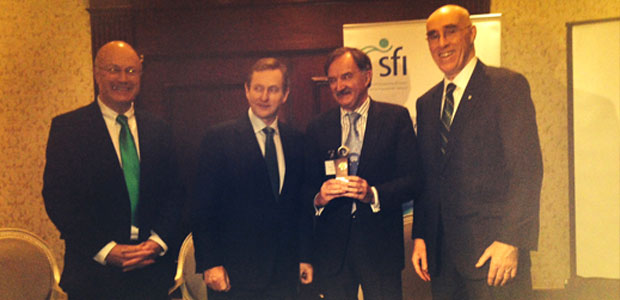
Dr. Garret A. FitzGerald, of the University of Pennsylvania, is first US based Irish scientist to be honoured with new Science Foundation Ireland (SFI) accolade. The Taoiseach, Enda Kenny T.D. presented Dr. FitzGerald with the inaugural SFI St. Patrick’s Day Science Medal at an Science Foundation Ireland hosted event in Washington D.C. The SFI St. Patrick’s Day Science Medal is intended to recognise the achievements of a distinguished Irish scientist or engineer, living and working in the USA, in particular their contribution back to Ireland.
Dr. Garrett Fitzgerald, M.D., upon receiving the first SFI Saint Patrick’s Day Medal from the Taoiseach, Enda Kenny T.D.
March 13, 2014 in Washington, D.C.
“I am honored and humbled to be the first recipient of the St Patrick’s Day Medal. Unlike the Oscars, I am given 3 minutes, not 47 seconds before the music starts to play.
I would like to thank Bill McLaughlin and his colleagues at the Irish American Business Chamber & Network, in Philadelphia, for nominating me.
I also thank Mark Ferguson and his colleagues at SFI, and Kingsley Aikins and his selection committee. The concept of an award to celebrate the scientific dimension of the long and happy relationship between Ireland and the US has a particular resonance for me.
Finally, I am delighted to be awarded this medal by Enda Kenny. I have great admiration for him. It is not often that the Vatican rearranges its game plan in response to the moral imperative of an Irish Taoiseach – as opposed to the other way around.
I would like to praise the Taoiseach and his political colleagues for having the vision to sustain, largely, scientific funding during such a dire economic crisis. It stands in contrast to the body politic in the US which has put at risk the scientific enterprise by allowing it be the unintended victim of such harebrained maneuvers as sequestration. The purchasing power of the NIH budget has declined by 20% over the past 5 years; a true disincentive to our young people to pursue a career in science.
Having praised the Irish, let me make two suggestions.
To take a leaf out of Jim Watson’s book, if you want good science, pay scientists more. It is a global game to recruit the best scientists and particularly in leadership, the remuneration for Irish scientists is seriously off the global pace. We cannot compete if this is not corrected. Great packages for science and wonderful space in which to conduct your experiments won’t cut it if the price of moving to Ireland is a pay cut. They won’t just come for the weather.
Secondly, we have heard some wonderful examples from Ireland of applied science this morning. However, the pendulum of funding needs to swing back to invest in the most fundamental science. It is out of basic science will come the unexpected discoveries that over the following 15-20 years will develop into products that benefit the health and wealth of the nation. Such investment and such patience are necessary for a sustainable enterprise. Otherwise we are eating our seed corn.
Finally, we have an appointment with destiny in Paris on Saturday. So, let me quote a Frenchman, Claude Bernard: “Art is I and science is we”.
Whatever about the first part, the second is certainly true.
It is surely unfair that I stand here receiving an award that reflects the work of so many people. I have had the privilege to work with many postdocs, graduate students, technicians and support staff over the years and it is their efforts that led to the achievements reflected in this prize. Of the 100 or so postdocs and graduate students, roughly one quarter of them are Irish; half still here and half back in Ireland.
Of course, the most important team supporting me has been Kate, my wife, and our children John, Genevieve and Hugo, two of whom are here today. Kate sacrificed her career to support all of us and our children made many sacrifices to enable the science we celebrate today. Without them I would not be here.”